Executive Summary
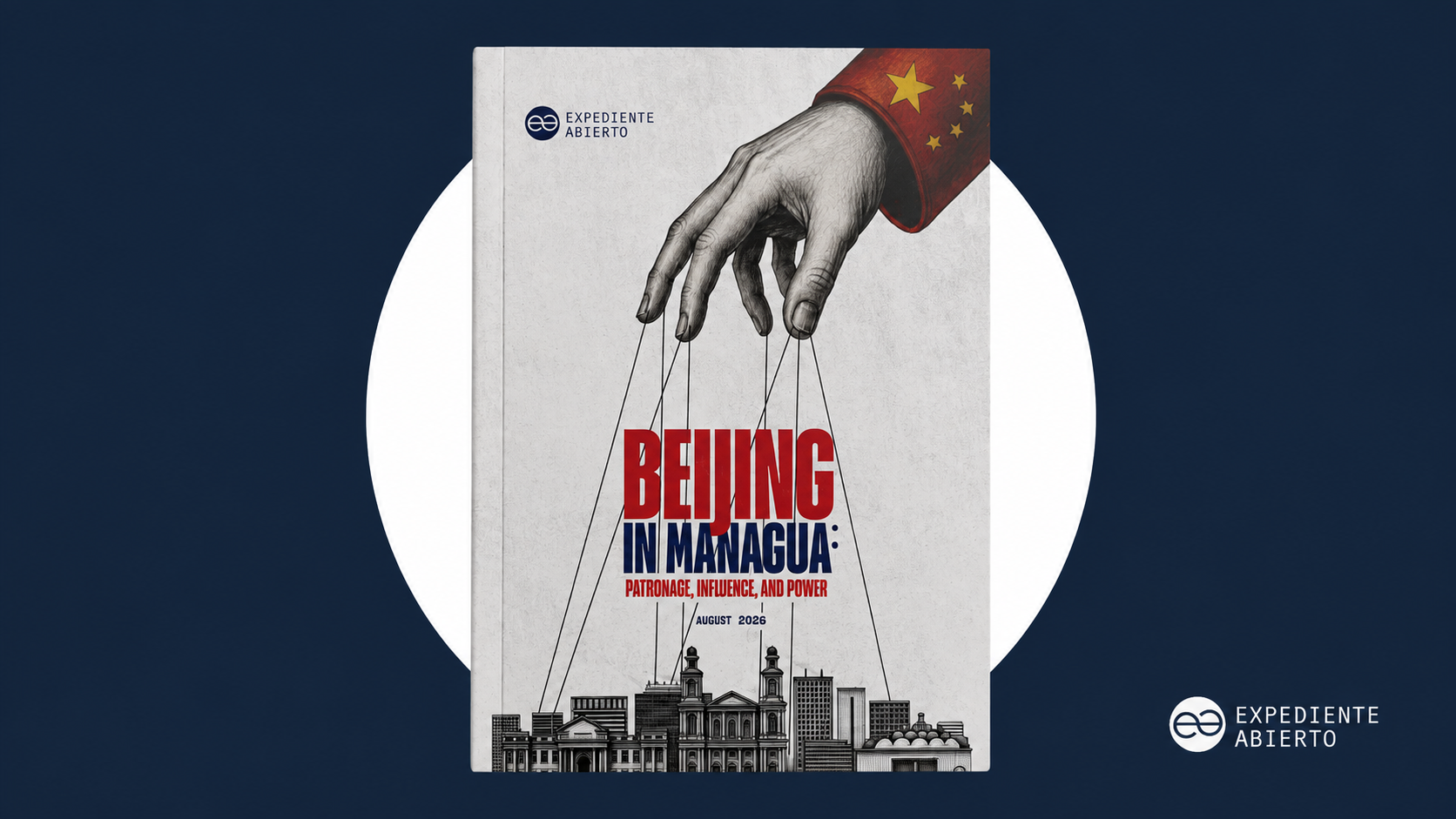
Since the reestablishment of diplomatic relations in 2021, the relationship between Nicaragua and the People’s Republic of China has evolved far beyond trade and investment. The evidence examined points to the consolidation of a strategic patronage relationship, through which Beijing combines economic, technological, institutional, and ideational resources to expand its influence while contributing to the resilience of the Ortega-Murillo regime.
Key Findings
- Insertion into strategic sectors: Chinese corporate presence is concentrated in infrastructure, energy, telecommunications, logistics, and mining—sectors that are critical to the functioning of Nicaragua’s economy and state apparatus.
- Growing economic dependence: Bilateral trade and financing mechanisms have produced an increasingly asymmetric relationship, deepening Nicaragua’s dependence on Chinese goods, technology, and capital.
- Elite capture and socialization: Cooperation includes training programs, party-to-party exchanges, judicial cooperation, university partnerships, and people-to-people diplomacy that strengthen ties between the Chinese Communist Party (CCP), the Sandinista National Liberation Front (FSLN), and key sectors of the Nicaraguan state.
- Centrality of the Ortega-Murillo family: Management of the relationship with China is highly concentrated within the ruling family, which serves as the principal political, economic, cultural, and media interlocutor in bilateral relations.
- Media cooperation and narrative production: Agreements between media organizations, journalist training programs, academic exchanges, and the expansion of institutions such as the Confucius Institutes contribute to the dissemination of narratives centered on sovereignty, non-interference, and China’s vision of international order.
- Strategic technological dimension: Chinese firms are involved in digital connectivity, telecommunications, emergency management, and energy infrastructure projects, creating long-term dependencies while expanding the presence of Chinese technological standards and platforms in critical sectors.
- Geopolitical implications: The expansion of Chinese influence in Nicaragua forms part of a broader competition between China and the United States over strategic infrastructure, digital governance, technological standards, and influence in the Western Hemisphere.
The Nicaraguan case demonstrates how China combines trade, financing, infrastructure, technology, institutional cooperation, and narrative production to build durable influence and strengthen ties with like-minded governments. This makes China a strategic challenge not merely because of its expanding economic footprint, but because these relationships can translate economic and technological dependence into lasting political leverage, strengthen authoritarian partners, and expand Chinese standards and platforms in sectors critical to regional security and governance. In Nicaragua, these dynamics acquire additional geopolitical significance given the country’s location in the Western Hemisphere and the Ortega-Murillo regime’s willingness to deepen strategic ties with Beijing.
Rather than a conventional economic partnership, the Sino-Nicaraguan relationship therefore constitutes an example of strategic patronage with implications extending beyond Nicaragua itself. It illustrates how Beijing can use bilateral relationships with politically aligned governments to establish long-term economic, technological, institutional, and political footholds, potentially reshaping the regional balance of influence and intensifying strategic competition between China and the United States in Latin America.