

Executive Summary
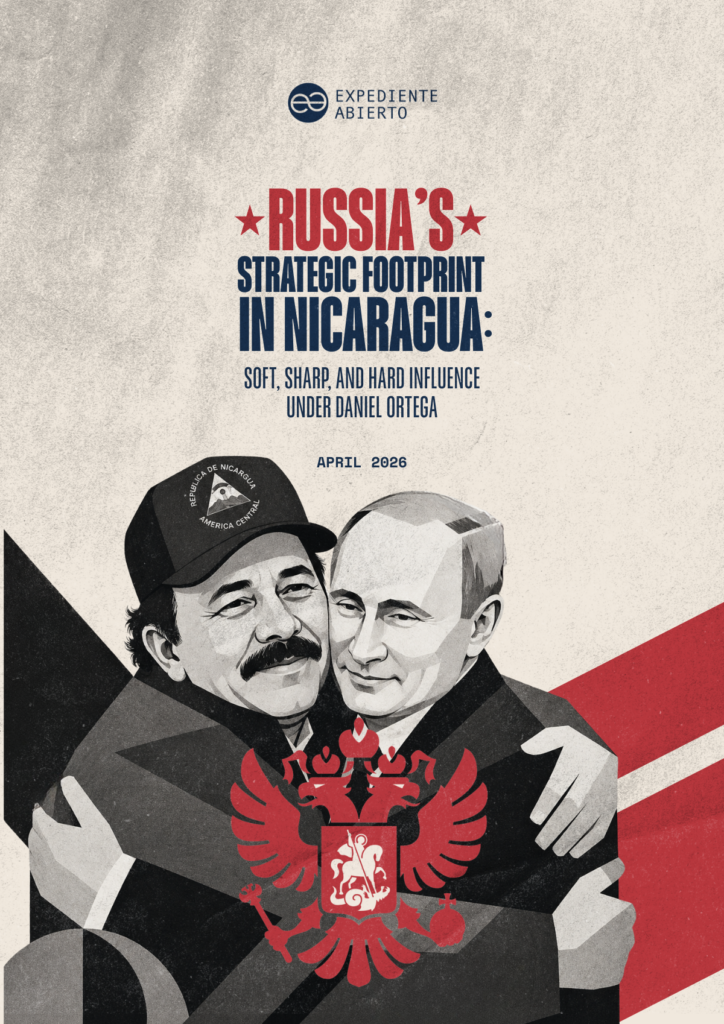
This report analyzes the evolution of the Russia–Nicaragua relationship between 2008 and 2025, highlighting a sustained but limited partnership in the Western Hemisphere. Since Daniel Ortega’s return to power, bilateral ties have developed steadily, supported less by economic exchange and more by political alignment and the strategic use of cultural and informational narratives. The relationship illustrates how influence can be consolidated through non-material mechanisms, even in the absence of strong economic engagement.
The analysis is based on economic data and an original dataset compiled by Expediente Abierto, drawing from 411 events identified in official government-aligned media. Using a framework that distinguishes between soft, hard, and sharp power, the findings show a clear predominance of soft power, which accounts for the majority of interactions. These include cultural, educational, and symbolic initiatives aimed at building legitimacy and long-term influence. Hard power, reflected in military cooperation and institutional support, and sharp power, associated with narrative projection and media control, appear less frequently but remain important components of Russia’s broader strategy.
The data also reveal a pronounced asymmetry in the relationship. Russia acts as a provider of political legitimacy, technical cooperation, and diplomatic support to the Ortega regime, particularly following the consolidation of authoritarian practices after 2018. Nicaragua, in turn, aligns strategically with Russia, reinforcing its narratives and international positioning. While this alignment offers short-term benefits, it raises concerns about geopolitical dependency, the erosion of democratic institutions, and the use of information and culture as tools of political control. Economically, the relationship remains shallow and intermittent, underscoring its primarily political and symbolic nature.
Despite limitations related to the use of publicly available sources and manual data coding, the findings point to a consistent pattern of influence projection centered on soft power, reinforced by selective hard and sharp tools. These dynamics highlight the need for stronger regional capacities to assess geopolitical risks, monitor external influence, and counter disinformation, particularly as extra-regional actors expand their presence in Central America.